In short: Every sample in digital audio has to be turned into sound at the instant the clock dictates. Tiny timing errors at the clock edges — jitter — distort the reconstructed waveform. The lower the jitter, the more natural the sound, and the less "digital" it feels. Vanadium II uses an OCXO as its system-wide clock reference, and accepts a 10MHz external clock.
Digital audio depends on the clock keeping time
CD audio is sampled at 44.1kHz: 44,100 samples per second, about 22.7 microseconds apart. At every clock edge the DAC converts one value into a voltage, and joined together these voltages form the waveform you hear.
The values are ones and zeros and do not go wrong. What can go wrong is when. If the clock edges arrive sometimes a little early and sometimes a little late, each sample is placed at the wrong moment and the waveform is distorted. That timing error is jitter.
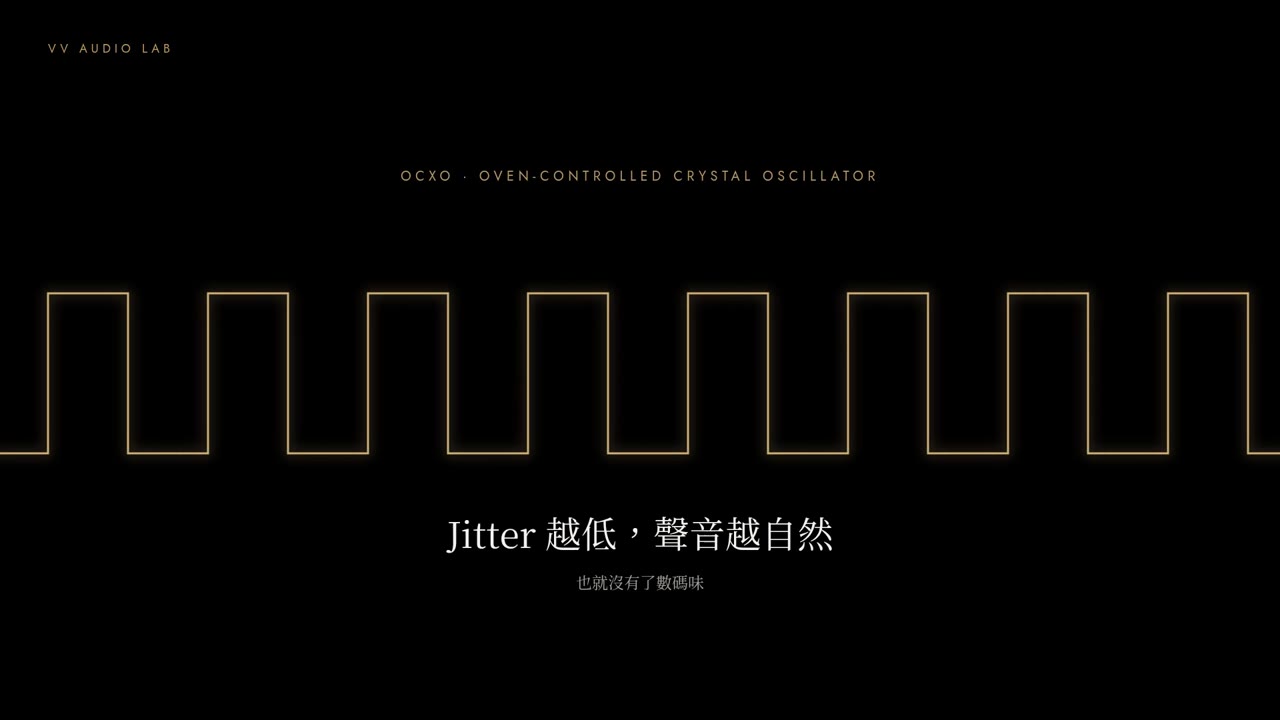
How timing errors become audible distortion
The faster a signal changes, the bigger the voltage error caused by the same timing error. For a sine wave of frequency f and amplitude A, the error is approximately:
voltage error ≈ 2π × f × A × Δt
For example, a full-scale 10kHz signal with 1 nanosecond (ns) of clock jitter has an error of about 0.0063% of full scale — roughly −84dB. That sounds small, but it is not evenly spread white noise: it is noise and sidebands that track the music and cling to the signal, landing right on the fine detail and sense of space the ear is most sensitive to.
This is why high-jitter systems are often described as sounding hard, with edgy treble and a blurred soundstage — what listeners call "digital sound".
OCXO: putting the crystal in an oven
Most electronics get their clock from a quartz crystal oscillator, and a crystal's frequency drifts with temperature. An OCXO (oven-controlled crystal oscillator) places the crystal inside a small temperature-controlled oven so that it always runs at the same temperature, which makes its frequency extremely stable.
Vanadium II uses an OCXO as its main frequency reference:
| Parameter | Specification | What it means |
|---|---|---|
| Frequency accuracy | ±0.2ppm | A 10MHz clock deviates by at most 2Hz. |
| Stability | ±0.5ppm | How steady the frequency stays in use. |
| Operating temperature | 0°C – 70°C | Consistent performance across this range. |
| Clock chip | LMX2594 | Generates the clocks the system needs from the reference. |
| External clock input | 10MHz | Lets a higher-grade external clock act as the reference. |
ppm and jitter are not the same thing
It is worth being clear: ppm describes frequency accuracy over the long term; jitter describes how the clock edges move back and forth over very short time spans, usually expressed as phase noise or in picoseconds. A good clock system takes care of both: the OCXO provides a stable, low-phase-noise reference, and the clock chip turns it into the frequencies each part of the system needs.
System-wide synchronisation, and the 10MHz external clock
Vanadium II uses a system-wide synchronised clock: a low-jitter OCXO serves as the clock reference for the entire system, improving the jitter performance of each component and the quality of digital signal transmission.
The rear panel has an EXT-CLOCK 10MHz BNC input. 10MHz is the standard reference frequency in recording studios and test equipment; if you already own a higher-grade reference such as a rubidium or GPS-disciplined clock, you can connect it directly and have the whole system follow the same clock. An indicator on the rear panel shows whether the internal (blue) or external (green) clock is in use.
A clock is only as clean as its power
One last point that is often overlooked: the clock circuit needs power too. Ripple and noise on its supply directly modulate the clock edges. So low jitter is not just a matter of fitting a better oscillator — it has to start with a clean power supply. See Why Music Servers Need Linear Power.
Vanadium II
OCXO system-wide synchronised clock, LMX2594 clock chip, 10MHz external clock input.
Discover Vanadium IIFrequently Asked Questions
A digital signal is just ones and zeros — how can jitter matter?
The values themselves are never wrong, but the moment each sample is converted into an analogue voltage is set by the clock. If that moment is off, the reconstructed waveform departs from its original shape. That timing error is jitter.
Does ±0.2ppm mean the jitter is very low?
Not exactly. ppm describes long-term frequency accuracy — for a 10MHz clock, ±0.2ppm means a deviation of at most 2Hz. Jitter is the very short-term back-and-forth movement of the clock edges, usually expressed as phase noise or in picoseconds (ps). Both matter, but they measure different things.
When do I need a 10MHz external clock?
When you already own a higher-grade reference, such as a rubidium or GPS-disciplined clock, or you want your whole system synchronised to a single clock source. Without one, the internal OCXO is already a high-precision reference.